
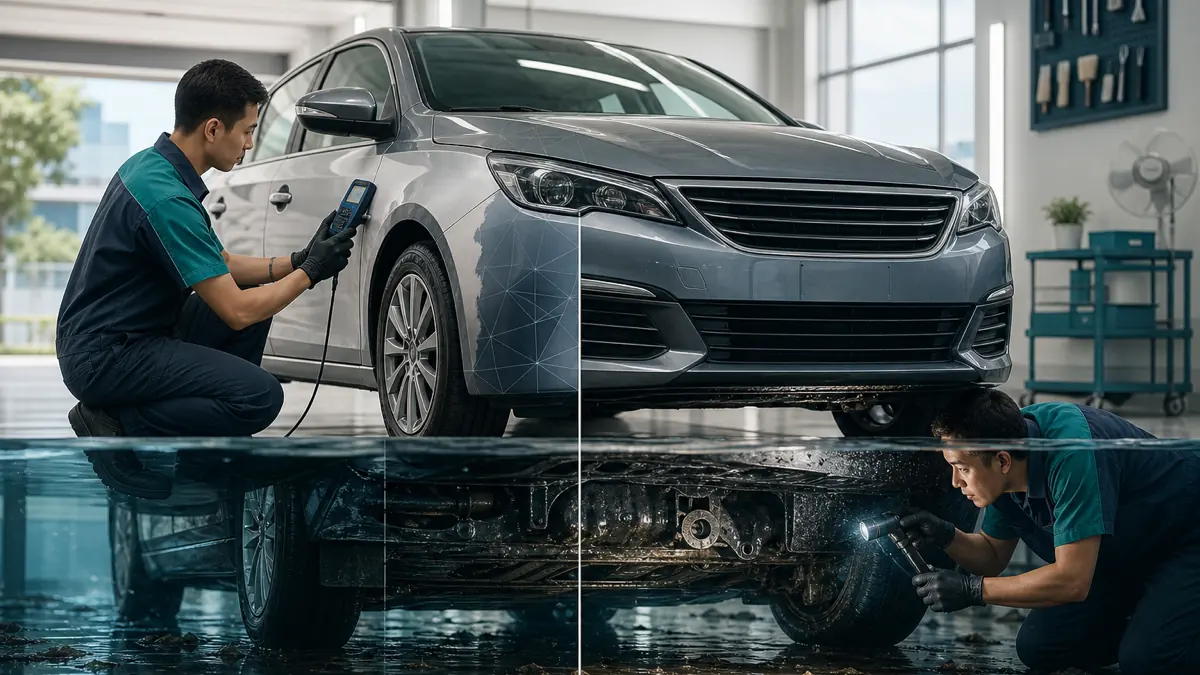
01Two identical cars, two very different prices
On paper, a price guide sees one car: 2019, 1.5L, automatic, 78,000 km. The market sees two — the clean one, and the one that has been underwater or rebuilt after a hard hit.
History is the variable that a year-and-mileage estimate cannot see, and it is often the variable that matters most. A car that has only ever had a bumper resprayed is, for practical purposes, a normal used car. A car that took structural damage and was straightened, or sat in monsoon floodwater for a day, is a different and riskier asset — even if it looks identical in the listing photos.
The honest way to think about it: a valuation gives you the price of a fair-condition example. History tells you whether the specific car in front of you earns that price, or whether it should sit well below the range. The two questions are separate, and you need both answers before money changes hands.
History the market actually prices in:
- Cosmetic damage — scratches, dents, kerbed rims, a resprayed panel. Minor, expected, barely a discount.
- Structural / chassis damage — a repaired hit that touched the frame, crumple zones, or suspension mounts.
- Flood exposure — submersion that reached the cabin, wiring, or engine, even once.
- Insurance write-off (total loss) — declared beyond economical repair, then rebuilt and put back on the road.
- Unclear or missing records — no service book, no repair invoices, a story that keeps changing.
02Accident vs flood: which damage actually hurts value
Not all damage is equal, and treating it that way is where buyers overpay and sellers under-price good cars. The market discounts damage in proportion to the risk it leaves behind, not the drama of the original event. A scraped door is forgotten in a week; a bent chassis or a soaked wiring loom follows the car for the rest of its life.
Minor
Cosmetic repairs
Small or no discount once done well
Major
Structural / chassis
Safety and resale risk both rise sharply
Severe
Flood-damaged cars
Deep discount; many buyers refuse outright
| Damage type | Typical value impact | Why the market reacts that way |
|---|---|---|
| Cosmetic (paint, dents, trim) | Small discount | Cheap and visible to fix; no effect on safety or reliability |
| Panel replacement (no frame) | Modest discount | Repairable to standard, but buyers want proof it was done right |
| Structural / chassis repair | Large discount | Affects crash safety and handling; hard to fully verify later |
| Flood / water damage | Severe discount | Corrosion and electrical faults appear over months, not at sale |
| Insurance write-off, rebuilt | Severe discount + friction | Status follows the car; narrows the buyer pool and financing |
03Why flood cars are a Malaysian monsoon trap
Flooding is not an edge case in Malaysia — it is a seasonal reality. The northeast monsoon brings heavy flooding to the east coast and low-lying parts of the Klang Valley most years, and every major flood event puts a wave of water-damaged cars onto the used market a few months later, often refurbished to look the part.
Water is uniquely destructive because it gets everywhere and stays. It wicks into seat foam and carpet underlay, sits in the floor pan, seeps into door cavities, and corrodes the dozens of electrical connectors a modern car relies on. Engine and transmission internals that ingested water can fail early even after a flush. None of this is visible in a quick look, which is exactly why flood cars carry the steepest discounts — and why many experienced buyers simply walk away rather than price the risk at all.
04How to read the car: inspection red flags
You do not need to be a mechanic to catch the obvious signs, and the obvious signs catch most problem cars. Inspect in daylight, look under and behind things, and trust your nose — a musty or heavily air-freshened cabin is a classic tell. When the visible signs and the seller's story do not match, raise your price risk, do not lower your guard.
Red flags worth a walk-away or a hard renegotiation:
- Uneven panel gaps or mismatched paint — a colour or texture that does not match the next panel suggests a repair.
- Fresh or mismatched welds and overspray — paint on rubber seals, or welds that look newer than the car, point to structural work.
- Musty smell, damp carpets, or water lines — a tide mark inside the boot, door sills, or under the dash is a flood signature.
- Rust where there should be none — under carpets, on seat rails, bolts, and bracket edges, especially on a younger car.
- Foggy lights, corroded connectors, or flaky electrics — moisture in headlamp clusters and intermittent electrical faults follow water damage.
- A service book that does not add up — gaps, no major-repair invoices, or an ownership story that changes when you ask twice.
- 1
Get the fair-condition benchmark first
Run a valuation so you know what a clean example is worth before you look at this one. Use a Carvaly valuation to anchor on a defendable range, not the seller's asking price.
- 2
Inspect for the red flags above
Daylight, all the angles, lift the carpets and check the boot well. Bring a torch and a magnet for suspected filler.
- 3
Get a professional check on anything serious
For a car you are otherwise sold on, a workshop or PUSPAKOM inspection is cheap insurance against an expensive history.
- 4
Price the risk, or walk
If history is confirmed, discount hard from the benchmark. If the story keeps shifting, walking away is a valid — often the best — outcome.
05Cosmetic vs structural: a buyer's-eye comparison
It helps to separate the two extremes side by side, because sellers often blur them — describing a serious repair in the same breezy tone as a car-park scrape. The difference is not the size of the original event; it is the size of the risk you inherit.
| Cosmetic repair | Structural / flood | |
|---|---|---|
| Affects safety? | No | Yes — crash structure or electrics |
| Visible to a careful buyer? | Usually, if done | Often hidden after refurbishment |
| Future reliability risk | Low | Elevated — faults can surface later |
| Effect on resale | Minimal | Lasting — narrows your future buyer pool |
| Fair pricing move | Small or no discount | Large discount, or do not buy |
If you are the seller of a genuinely clean car, this comparison is your friend. Documented service history, original paint, and a verifiable single-owner story are exactly what let you hold the upper end of a defendable range instead of being lumped in with the rebuilds.
06Disclosure protects both sides
Honesty here is not just ethics — it is risk management. A seller who conceals a material accident or flood history is exposed if it surfaces after the sale, and in Malaysia it often does, because the buyer's own workshop or the next valuation finds it. The transfer of ownership through JPJ does not erase a car's physical past.
The strongest position in a used-car deal is not a perfect car. It is a known one — where both sides can see the history and agree on a fair price for it.
Frequently asked questions
How much does accident history reduce a car's value in Malaysia?
It depends entirely on the type of damage. A repaired cosmetic knock barely moves the price; a structural or chassis repair commands a large discount because it raises safety and resale risk. The number is not fixed — it scales with severity, repair quality, and how well it is documented.
Is it safe to buy a flood-damaged car if the price is very low?
Treat it with extreme caution. Flood water leaves corrosion and electrical faults that often surface months after the sale, long after any warranty or goodwill. A low price may not cover the repairs and reliability risk you inherit. Many experienced buyers refuse water-damaged cars outright rather than gamble on the discount.
How can I tell if a used car has been in a flood?
Inspect in daylight and use your senses: a musty or heavily perfumed cabin, damp or stained carpets, rust under seats and on bolts, water lines in the boot or door sills, and foggy headlights or flaky electrics. If several signs line up — or the price looks too good for the condition — assume water history and verify before paying.
Do I legally have to disclose accident or flood history when selling?
Concealing a material defect you know about creates real legal and reputational risk if it surfaces after the sale, and in practice it usually does. Beyond the legal exposure, disclosure with evidence — invoices, insurance records, photos — actually helps an honest, well-repaired car sell at a fair price instead of collapsing at inspection.