
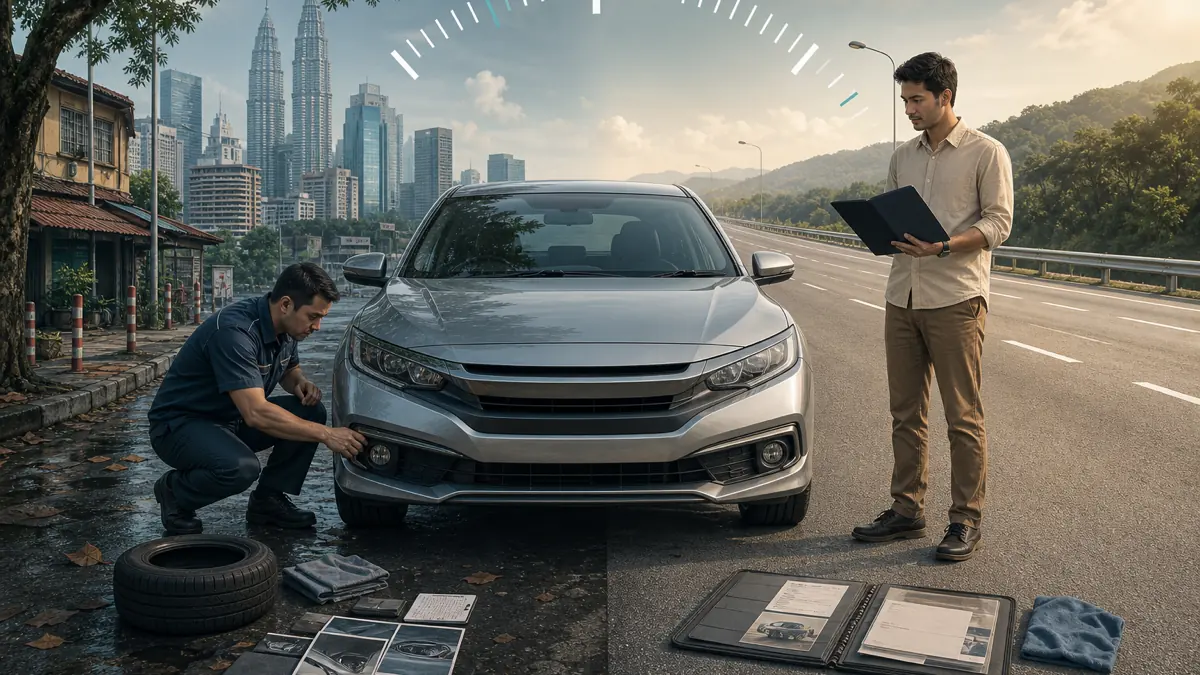
01What 'normal' mileage looks like in Malaysia
Before mileage can move a price, you need a like-for-like baseline. Compare cars of a similar age, model, variant, location, and observation date rather than relying on one national kilometre rule.
A useful first sense-check is to divide the odometer by the car's age, then compare that result with current listings for the same model and age. A reading well below the comparable group can suggest light use; one well above it can suggest heavier use. Neither conclusion is reliable until the service record and condition agree.
Age
adjust the reading
Compare annualised use, not the odometer alone
Like for like
match the cohort
Model, variant, location, and observation date matter
Evidence
verify the story
Condition and service records decide whether it is credible
There is no universal hard cut-off. A higher-mileage car that has been serviced on time and driven gently on highways can be in better mechanical shape than a lower-mileage car used only for short, cold, stop-start city trips. Mileage sets the expectation; condition and records decide the verdict.
02Why mileage moves the price at all
Buyers do not pay for kilometres directly — they pay for the wear those kilometres represent and the remaining life they expect to get. Every kilometre brings the next round of tyres, brakes, belts, bushes, and clutch wear a little closer. Higher mileage means more of those costs sit in the near future, so the market prices them in as a discount.
That is why the same model, year, and variant can carry meaningfully different price tags purely on the odometer. Above-average mileage signals more imminent maintenance and shorter remaining life, so it pulls the fair price down. Genuinely low mileage signals the opposite — less wear, more road ahead — so it earns a modest premium, provided it can be proven.
03Mileage is a proxy — not the whole story
The most common mistake is treating the odometer as a verdict. It is a proxy: a fast, imperfect stand-in for wear that you are meant to verify, not trust blindly. Two cars can read the same mileage and be worth different money because of how those kilometres were driven and how the car was looked after.
What the odometer cannot tell you on its own:
- How the kilometres were driven — gentle highway cruising is easier on a car than constant short, stop-start city trips.
- Whether servicing kept pace — skipped oil and timing services age an engine faster than the number suggests.
- The car's history — accident, flood, or repair history changes value far more than a few thousand kilometres.
- Remaining life on wear items — tyres, brakes, and belts can be due regardless of a flattering odometer.
04Service history versus the odometer
When mileage and paperwork point in different directions, the paperwork usually wins. A full service history — stamped book or workshop invoices that track the odometer climbing over time — turns the mileage from a claim into a verifiable record. That is exactly the kind of evidence that lets a careful seller hold a price and a careful buyer pay one.
| Scenario | How the market reads it | Effect on value |
|---|---|---|
| High mileage + full records | Used honestly and maintained | Mild discount, but trusted |
| Low mileage + full records | Lightly used and proven | Premium the market will pay |
| Low mileage + no records | Unverifiable — possibly suspect | Premium evaporates; buyers wary |
| High mileage + no records | Hard use, unknown upkeep | Steepest discount and slow sale |
Mileage is one input among many, not a standalone score. Get a Carvaly valuation for estimated ranges on your exact car — so you negotiate from a saved report instead of arguing over kilometres alone.
05Odometer tampering: spotting a rolled-back clock
A digital dashboard does not make an odometer honest. Mileage can be wound back, and an unusually low reading on an older car is the single biggest reason to slow down and verify before any money changes hands. The good news is that a tampered odometer almost always leaves a trail elsewhere.
- 1
Cross-check the service history
Compare the odometer against dated service stamps and invoices. Mileage that jumps around, stalls, or goes backwards across visits is the clearest warning sign.
- 2
Match wear to the number
A worn steering wheel, shiny pedals, sagging seat bolsters, and tired carpets may not fit a very low-mileage claim. Wear should match the reading.
- 3
Read inspection and transfer records
Mileage is noted at inspection and ownership-transfer points. A reading lower than a past official record is a hard red flag.
- 4
Get an independent check when unsure
If the story does not add up, a professional inspection or a paid history report costs far less than buying a clocked car.
An odometer is a claim until the service book, the wear, and the records agree with it. Trust the evidence, not the number on the dash.
06What buyers and sellers should actually do
Mileage is something you can frame, not just accept. Sellers who present it honestly and back it with records protect their price; buyers who read it in context avoid overpaying for a flattering number or panicking over an honest high one.
If you are selling
- Do not apologise for mileage if the car is priced correctly and the service records are strong.
- Gather the service book and invoices so the odometer reads as a verified record, not a claim.
- Price honestly for above-average mileage rather than hoping a buyer overlooks it at inspection.
If you are buying
- Do not overpay for a low number without checking condition, records, and history.
- Treat a too-good odometer on an older car as a reason to verify harder, not to rush.
- Use evidence of how the market really discounts similar mileage so you negotiate from facts, not feel.
Frequently asked questions
What counts as high mileage for a used car in Malaysia?
There is no defensible universal line. Compare annualised mileage with current, genuinely similar cars of the same model and age. A reading well above that group deserves closer inspection, though full service records can make a higher-mileage car a safer buy than a lower-mileage one with no history.
Does low mileage always mean a higher price?
Only when it can be proven and the condition matches. Genuinely low mileage with a full service book earns a modest premium. Low mileage with no records, or on a car that has clearly been sitting, makes buyers cautious and the premium disappears.
How much does mileage actually change a car's value?
It is one factor among several, not a fixed percentage. The direction and size of any adjustment must come from a dated group of comparable cars for the same model, age, specification, location, and condition. Without that evidence, a precise percentage would be guesswork.
How do I check if an odometer has been tampered with?
Cross-check the reading against dated service stamps, invoices, and past inspection or transfer records — mileage that stalls or goes backwards is the clearest sign. Make sure interior wear matches the number, and get an independent inspection or history report if anything looks off.
Should I buy a high-mileage car with full service history?
Often yes. A high-mileage car with complete, on-time records and matching condition is frequently the lower-risk choice over a cheaper low-mileage car with no paperwork and an unknown past. Documentation is what tells you the kilometres were honest and the car was cared for.