
01Start with price, not paperwork
The cleanest transfer in the world still loses money if the number was wrong. So the first checklist item is not a form — it is the price.
Once an inspection is booked and forms are in motion, both parties feel committed, and a price set too high or too low becomes awkward to revisit. Settle the figure while it is still easy to walk away. Agree a fair range, agree where inside it this specific car sits, and only then start the official process. Price clarity up front is what makes every later step calm.
Get a Carvaly valuation right before you transfer so both sides anchor on the same estimated ranges. It is an independent valuation, not a mechanical inspection or a guaranteed sale price — but it turns "what's it worth?" into a report you can both stand behind before money moves.
2
Government touchpoints
PUSPAKOM inspects; JPJ transfers ownership
Both
Parties verify identity
Seller and buyer, in person or via JPJ's channels
1
Confirmation that matters
Proof the transfer actually completed at JPJ
02What each side brings to the table
A transfer stalls most often because a document is missing, expired, or does not match. Get the paperwork lined up before the appointment, and the rest moves quickly. Names on the IC, the registration, and the insurance should all agree; a mismatch (a maiden name, an old address, a company versus an individual) is exactly the kind of detail that sends you home to come back another day.
Have these ready before you book anything:
- Seller's MyKad and the buyer's MyKad — original identity documents for both parties.
- Vehicle registration / geran — the registration certificate (the modern e-Daftar record, or the older physical card where it applies).
- Loan settlement / clearance — if the car is financed, written proof the financier has been fully settled and will release its interest.
- Valid road tax — the vehicle should be properly licensed; expired road tax is a problem to fix, not ignore.
- A live insurance plan for the car — the buyer arranges their own cover to take effect on transfer (see the handover section).
| Document | Seller | Buyer |
|---|---|---|
| MyKad (identity) | Required | Required |
| Vehicle registration / geran | Provides | Verifies it matches the car |
| Loan settlement letter | Required if financed | Confirms it exists before paying |
| Road tax status | Should be valid | Checks validity / expiry |
| Insurance | Cancels / refunds own policy | Arranges new cover on transfer |
| PUSPAKOM inspection result | Usually arranges / attends | Confirms it passed |
03The PUSPAKOM inspection (and when you need it)
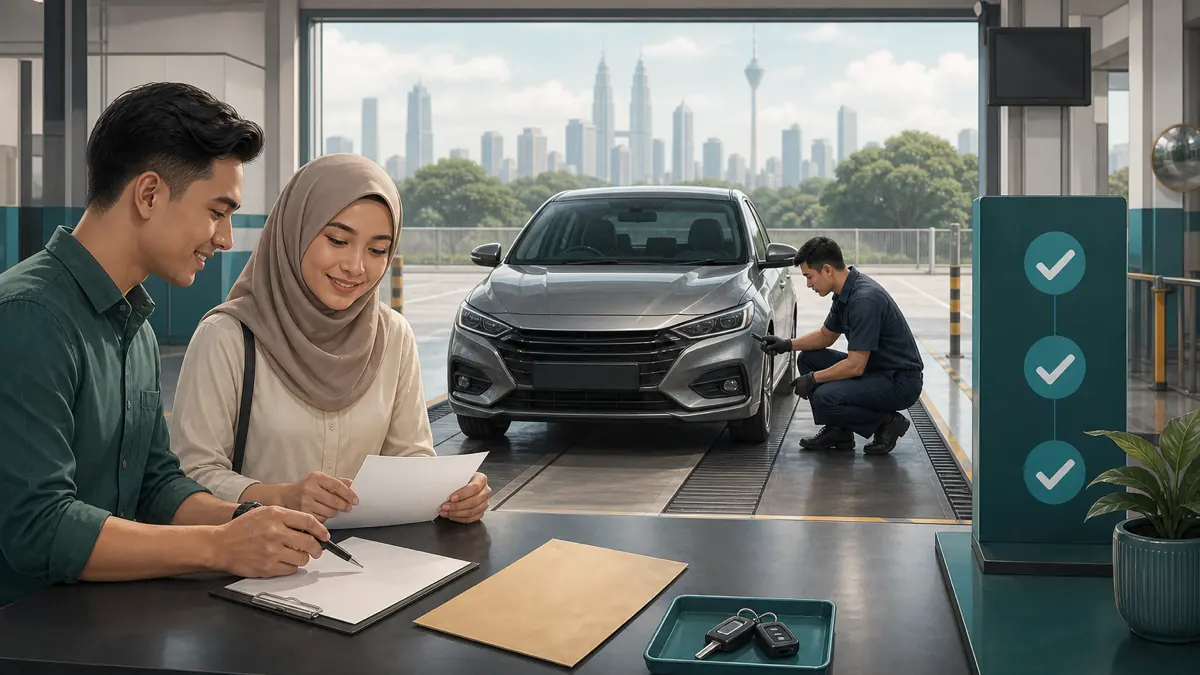
PUSPAKOM is Malaysia's appointed vehicle inspection body, and a private ownership transfer normally requires its inspection — commonly the transfer-of-ownership inspection (the B5). The purpose is to confirm the vehicle's identity and basic roadworthiness: that the chassis and engine numbers match the registration, and that the car is the car the documents describe. Book the slot in advance through PUSPAKOM's appointment channel; turning up without one can mean a wasted trip.
For the buyer, the inspection is also quiet protection. It is not a full mechanical health check or a guarantee of condition, but a clean result is one more signal that the car's identity is genuine and that nothing obvious is being hidden. Treat a failed or deferred inspection as information, not a nuisance — it tells you something the seller may not have.
| Typical private transfer | When extra steps apply | |
|---|---|---|
| PUSPAKOM inspection | Required (transfer/B5 inspection) | Same, and may be re-checked if it fails |
| Who attends | Seller commonly brings the car | By arrangement between the parties |
| Loan on the car | None — straightforward | Must be settled and released first |
| Booking | Appointment in advance | Appointment in advance; allow buffer time |
04The JPJ transfer, end to end
JPJ (Jabatan Pengangkutan Jalan) is the authority that actually moves ownership from one name to another. Here is the sequence for a typical private sale, in the order that keeps everyone protected. The throughline: do not let money and ownership cross at the wrong moment.
- 1
Price and agree
Run an independent valuation, agree the figure and the terms, and confirm whether there is an outstanding loan before anything else.
- 2
Clear any financing
If the car is financed, the seller settles the loan and obtains written confirmation that the financier releases its interest. Until that is done, the car cannot transfer cleanly.
- 3
Pass the PUSPAKOM inspection
Book and attend the transfer-of-ownership (B5) inspection so the vehicle's identity and basic roadworthiness are confirmed.
- 4
Verify identity at JPJ
Both seller and buyer complete JPJ's identity verification for the ownership transfer. This is the formal step that prevents fraudulent transfers.
- 5
Submit the transfer
Lodge the ownership transfer with JPJ with the registration, settlement proof, and inspection result in hand.
- 6
Confirm completion
Get proof from JPJ that the transfer is done and the car now sits under the buyer's name — then settle payment and handover in step with it.
05Confirm it completed — then road tax and insurance
Handover is not the finish line. The transfer is only complete when JPJ's records show the buyer as the owner — and that detail protects the seller as much as the buyer. If the car is still registered to the seller, the seller can remain exposed to liabilities tied to it. Do not rely on a verbal "it's done"; confirm it in JPJ's records before you consider the deal closed.
Insurance and road tax travel with ownership. The buyer should have their own insurance ready to take effect on transfer, because the seller's policy does not carry over to a new owner; road tax (LKM) and the buyer's cover should be sorted so the car is legally on the road from day one. The seller, in turn, can cancel their old policy and claim any refund once they are no longer the registered owner.
06Common pitfalls — and how to dodge them
Most transfer problems are predictable, and almost all of them are avoidable with a little discipline. Trust the process, not a reassuring chat message.
Watch for these:
- Paying before the loan is cleared — never assume; insist on written settlement and release of interest from the financier.
- Name or detail mismatches on the IC, registration, or insurance — reconcile them before the appointment.
- Skipping the inspection to save time, then inheriting an undisclosed problem.
- Treating handover as the end — chase the JPJ confirmation so ownership and liability actually move.
- Letting insurance lapse at the seam — the buyer's cover should start exactly when ownership transfers.
- Outsourcing trust to a message — keep documents, identity, inspection, payment, and transfer status aligned, in that order.
A transfer is not finished when the keys change hands. It is finished when the records prove the car is no longer yours.
Frequently asked questions
Do I need a PUSPAKOM inspection to transfer a used car privately?
For a normal private ownership transfer, yes — PUSPAKOM's transfer-of-ownership inspection (the B5) is generally required to confirm the vehicle's identity and basic roadworthiness. Book the appointment in advance, and verify the current requirement with PUSPAKOM, as categories and fees can change.
What if the car still has an outstanding loan?
It cannot transfer cleanly until the financier is settled and formally releases its interest. The seller should obtain written settlement confirmation, and the buyer should see proof that release exists before paying. If the loan is larger than the car is worth, treat that negative-equity gap as part of the price discussion, not a surprise at the counter.
How do I confirm the JPJ transfer actually completed?
Do not rely on a verbal assurance. Confirm through JPJ that the vehicle now sits under the buyer's name. Until JPJ's records show the new owner, the seller can remain liable for the vehicle, so this confirmation is the step that truly closes the deal.
What happens to road tax and insurance on transfer?
Insurance does not carry over to a new owner — the buyer arranges their own cover to take effect on transfer, and road tax should be valid so the car is legal from day one. The seller can cancel their old policy and claim any refund once they are no longer the registered owner.
Should I pay before or after the ownership transfer?
Keep money and ownership moving in step. Avoid paying a large sum before the transfer path is clear, and as a seller avoid releasing ownership before payment has truly cleared. Sequencing them together is what stops either party from being exposed.