
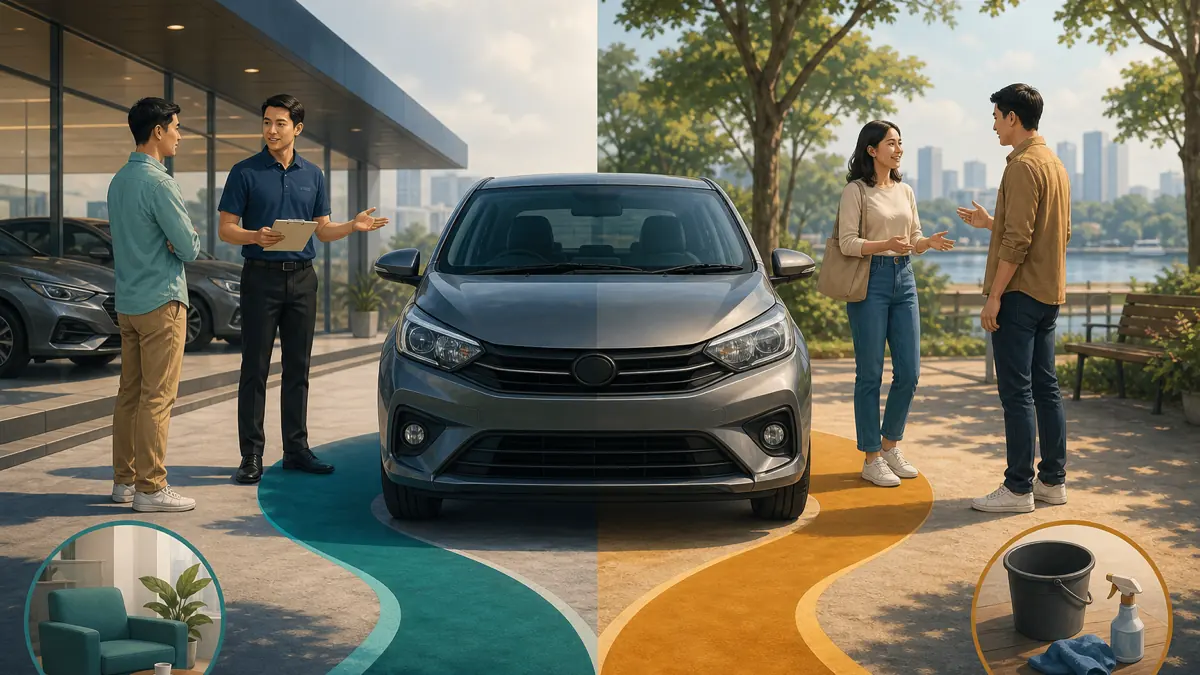
01Speed and certainty, or a higher price
Every Malaysian seller faces the same fork: take the fast, certain offer, or hold out for the higher number. Both are valid — the mistake is choosing before you understand what each one really costs.
A trade-in or instant cash offer collapses the whole sale into one appointment. The buyer is ready, the paperwork moves on rails, and if you have an outstanding loan they can usually settle it directly with the bank and net off the difference. You drive in undecided and drive out done — often within a day or two.
A private sale points the other way. You are the one who lists the car, fields the messages, hosts the viewings, negotiates, verifies payment, and walks the transfer through JPJ. It is more work spread over more days — but because you cut out the middleman's margin, the gross price is usually higher.
What each path really is
- Trade-in / instant offer — one buyer, one appointment, loan settlement and paperwork handled for you. Fast and certain, but the offer is net of the dealer's margin.
- Private sale — you market and sell directly to an individual buyer. Higher gross price, but you carry the time, screening, negotiation, and transfer admin yourself.
02Net, not gross: what you actually walk away with
The two paths are almost never compared fairly, because people line up a private-sale asking price against an instant offer as if they were the same kind of number. They are not. One is a hopeful gross before any cost or effort; the other is a firm net you can bank today.
Gross
Private sale headline
Before time, effort, and risk are deducted
Net
Instant offer in hand
Firm, settles the loan, paperwork handled
Days→weeks
Typical private-sale timeline
Listing, viewings, negotiation, transfer
To compare honestly, take the private-sale figure and subtract the real costs: the hours spent messaging and showing the car, the chance a deal collapses and you relist, the small risk of a payment scam, and the patience it takes to wait for the right buyer. What remains is the true net — and that is the only number worth holding against the instant offer.
Before you can weigh either, you need a defendable anchor. Get a Carvaly valuation so the instant offer and your private asking price are both measured against estimated ranges you can save and share, not against hope or fear.
03Trade-in vs private sale, side by side
Laid out across the dimensions that actually decide it, the trade-off becomes clear. Neither column wins outright — each is strong exactly where the other is weak.
| Trade-in / instant offer | Private sale | |
|---|---|---|
| Speed | Fast — often a day or two | Slow — days to weeks |
| Typical price | Lower (net of margin) | Higher gross, if you wait |
| Effort | Minimal — one appointment | High — listing, viewings, negotiation |
| Paperwork | Handled for you | Yours — JPJ transfer, settlement |
| Risk | Very low — firm, vetted buyer | Higher — payment fraud, no-shows |
04What a private sale actually asks of you
The higher gross price of a private sale is real, but it is earned. Going in with eyes open is what keeps a private sale worth it instead of a slow, stressful detour to roughly the same net.
- 1
Price and list from evidence
Set an asking price anchored to a defendable range, write an honest listing, and take clear photos. A price built on real comparables draws serious buyers and deflects lowballers.
- 2
Screen the messages
Expect time-wasters, swap-and-trade offers, and the occasional scam opener. Qualify buyers before committing to a viewing, and never share documents or accept odd payment arrangements.
- 3
Host viewings and test drives safely
Meet in public, daylight spots, verify a licence before any test drive, and keep your own copy of the car's documents. This is the part that costs the most patience.
- 4
Confirm payment before you hand over
Wait for cleared, irreversible funds — not a screenshot of a transfer. Settle any outstanding loan first so the title can actually move.
- 5
Complete the JPJ transfer
Ownership transfer runs through JPJ, with PUSPAKOM inspection where required. Until the transfer is done, the car is legally still yours — finish it the same day.
05Which path fits you
There is no universally right answer — only the right answer for your week, your patience, and your risk appetite. Match your situation to one of these, and the choice gets easy.
Choose a trade-in or instant offer if
- You need the cash or the next car quickly, or you are buying a replacement in the same visit.
- You have an outstanding loan and want the buyer to settle it and handle the paperwork.
- Your time is scarce or valuable, and the certainty of a firm, done-today price is worth a few thousand ringgit.
- You would rather avoid strangers, viewings, and any chance of a payment scam.
Choose a private sale if
- You have weeks, not days, and the patience to wait for the right buyer.
- Your car is in strong, well-documented condition — the kind of car private buyers pay a premium for.
- You are comfortable screening buyers, negotiating, and walking the JPJ transfer yourself.
- The realistic net premium over the best instant offer is large enough to pay you fairly for the effort and risk.
06Run the numbers before you commit
Both paths get better the moment you stop guessing. A clear-eyed table of what each costs and returns turns a gut decision into a deliberate one — and a defendable market range keeps both numbers honest.
| Decision factor | Trade-in / instant offer | Private sale |
|---|---|---|
| Headline price | Lower, but firm and net | Higher gross, not guaranteed |
| Time to cash | A day or two | Often two to six weeks |
| Your effort | Almost none | Significant and ongoing |
| Loan settlement | Handled by the buyer | Your responsibility first |
| Paperwork / transfer | Done for you | You complete it via JPJ |
| Risk of a bad outcome | Very low | Real — fraud, fall-through |
The seller who wins is not the one chasing the highest number — it is the one who knows the fair range and picks the path that keeps the most of it.
Frequently asked questions
Is a trade-in or private sale better in Malaysia?
Neither is universally better. A trade-in or instant offer is faster, lower-risk, and handles your loan and paperwork, but pays less. A private sale usually clears a higher gross price if you have the time and patience. Compare the net you actually keep — not the gross you are quoted — after factoring in effort and risk.
How much less does a trade-in or instant offer pay?
It varies by car and demand, but the offer is always net of the buyer's reconditioning, holding, and resale costs, so it sits below a patient private sale. The right way to judge it is to get a defendable market range first, then see how far the offer sits below it — and whether that gap is worth the convenience.
Can I trade in a car that still has an outstanding loan?
Yes — this is one of the biggest advantages of a trade-in or instant offer. The buyer can usually settle the outstanding amount directly with your bank and net off the difference, so you avoid the cash-flow gap of clearing the loan yourself before a private buyer will commit.
What are the risks of selling my car privately?
The main ones are payment fraud (fake transfer screenshots or reversible payments), no-shows and time-wasters, and incomplete ownership transfer leaving the car legally yours. Meet in public, wait for cleared funds before handing over, settle any loan first, and complete the JPJ transfer the same day.
Should I get an instant offer even if I plan to sell privately?
Yes. An instant offer is a free, firm price floor. It tells you the worst-case certain price, gives you a number to beat in a private sale, and is there to fall back on if listing drags. Knowing it makes you a calmer, better-anchored seller either way.