
01Location is part of the price, not noise around it
The same 2019 hatchback can be worth a few thousand ringgit more in Petaling Jaya than in Kuala Terengganu — and that gap is not a mistake. It is the market telling you where the buyers are.
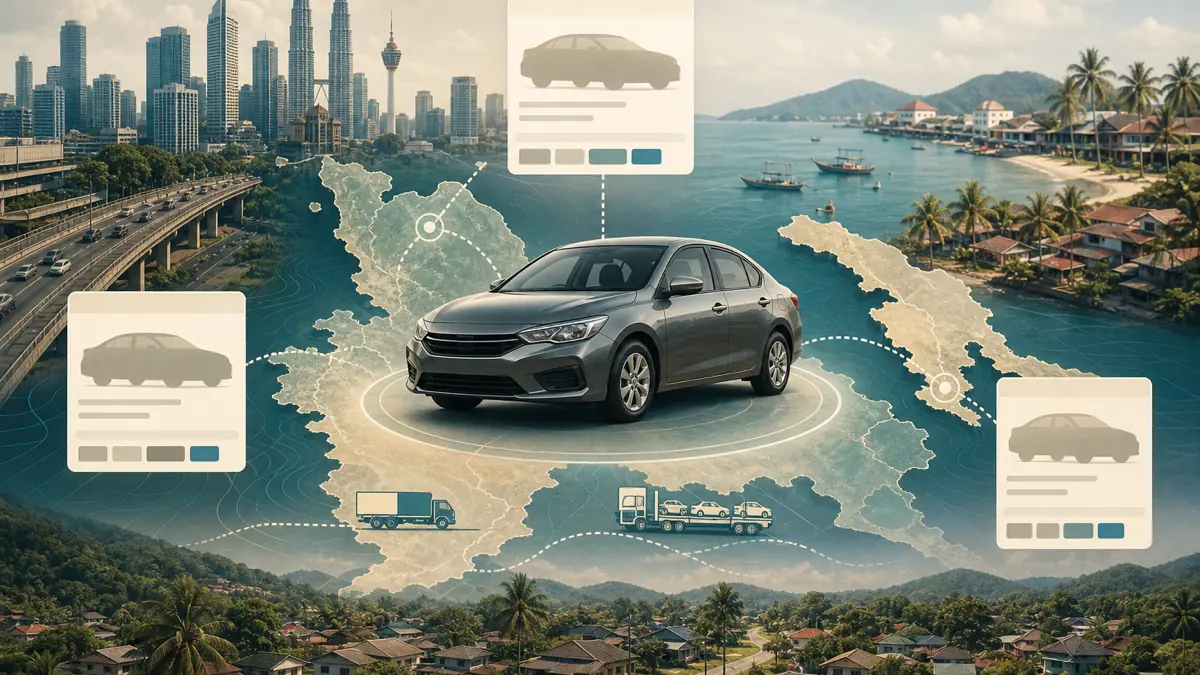
Malaysia is one country but several different used-car markets stitched together. A used car's price is set by the buyers who can realistically reach it, and those buyer pools change sharply as you move from the Klang Valley to the east coast, north to Penang, south to Johor, and across the sea to Sabah and Sarawak. Demand depth, the number of comparable cars for sale, financing appetite, and even the cost of physically moving a car all shift with the map.
That is why a single national figure is a weak anchor. An average quietly blends a fast, crowded Klang Valley market with thinner markets where a car might sit for weeks. Treat the national number as a national average — useful for headlines, dangerous as your asking price.
02Why the Klang Valley sets the pace
The Klang Valley — Kuala Lumpur and Selangor — is the centre of gravity for Malaysian used cars. The population is dense, incomes and financing access are high, and dealers and private sellers list constantly. That combination makes it the most liquid market in the country: lots of supply, lots of demand, and fast, visible price discovery.
Deepest
Buyer pool
Highest population density and financing access
Most
Comparable listings
More cars for sale means tighter price discovery
Fastest
Turnaround
Liquid demand clears well-priced cars quickly
Liquidity matters because it tightens the range. When dozens of near-identical cars are listed near a buyer, nobody has to overpay and a seller cannot drift far above the pack without being ignored. In a thin market the same car has fewer reference points, so prices are softer, slower to move, and far more dependent on one or two motivated buyers showing up.
03How the regions actually differ
Outside the Klang Valley, three forces reshape price: how many buyers are nearby, what those buyers prefer, and how hard it is to get cars in and out. The figures below are illustrative — they show the shape of the differences, not fixed amounts for any specific model.
Penang and Johor have their own strong urban markets — Johor in particular has cross-border demand dynamics and a steady flow of cars. East-coast states such as Kelantan, Terengganu, and Pahang have smaller, more dispersed buyer pools, so the same car can ask less and still take longer to sell. Model preferences also shift: rugged, practical, fuel-sipping models often resell more easily outside the big-city centres.
Sabah and Sarawak are their own market
East Malaysia is not just 'further away' — it is a structurally different market. Supply mixes are different, some models are scarcer, and moving a car across the South China Sea adds real cost and time. That can support firmer prices for cars that are already there (because replacing them is expensive) while making it impractical to chase a cheap Peninsular listing you would have to ship over.
04Transport cost is the bridge between two regions
Whenever a price looks better in another region, the honest question is: what would it cost to actually move the car here? Transport is the bridge between two regional prices, and it is rarely free. A long peninsular tow, or shipping to or from Sabah and Sarawak, can quietly erase the 'saving' that made a far-away listing look attractive.
Factor these into any cross-region comparison:
- Transport or delivery cost — peninsular long-haul, or roll-on/roll-off shipping to East Malaysia, plus time off the road.
- Inspection you cannot do in person — buying sight-unseen across regions raises risk, so price in a bigger safety margin.
- Ownership transfer logistics — follow the JPJ ownership-transfer guide and arrange any required inspection through PUSPAKOM's official appointment channel; distance can add coordination and transport costs.
- Local demand on resale — a car that is rare locally can be harder to sell again, even if it was cheap to bring in.
05How buyers and sellers should use regional context
Regional context is not a reason to feel cheated by a low local price or to over-hope on a high far-away one. It is information you can act on. The goal is simple: price against the cars your buyer can really choose between, and let location work for you instead of against you.
- 1
Value with the right region
Value the car for its actual location, not a national blend. Reading a Carvaly valuation with the correct region keeps the range honest.
- 2
Sell where the demand is
If you can reach a deeper market without big cost, a more liquid region often clears faster and firmer. If not, accept the local range rather than fighting it.
- 3
Price transport into every cross-region comparison
Add delivery, shipping, inspection risk, and transfer hassle before calling a far-away listing 'cheaper'. Compare landed cost, not sticker price.
- 4
Widen your margin where the market is thin
In a thin or rural market, negotiation gaps are larger and sales are slower — set a realistic price and a patient timeline, and lean on comparables you can show.
06Why a national average misleads — and what to use instead
A national average answers a question almost nobody is actually asking: 'what is this model worth everywhere at once?' Real buyers and sellers are always somewhere specific, with a specific set of nearby alternatives. The average is a starting orientation; regional evidence is what you negotiate with.
| Signal | What it tells you | How to use it |
|---|---|---|
| National average | Rough orientation | Sanity-check only — never your asking price |
| Local comparable listings | Real local demand and supply | Anchor your range here |
| Market depth (liquidity) | How firm prices are | Negotiate firmer where it's deep, wider where it's thin |
| Transport / landing cost | True cost of a far listing | Compare landed cost, not sticker price |
| Model popularity locally | How easy resale will be | Factor into both price and time-to-sell |
Used well, region is an edge, not a complication. The seller who prices to local evidence sells at a fair number without waiting forever; the buyer who reads regional depth knows when a price is genuinely good versus merely far away. Both beat the person anchored to a single national figure.
Frequently asked questions
Why is the same used car cheaper in one Malaysian state than another?
Because the buyers who can realistically reach it differ by region. The Klang Valley has the deepest, most liquid market, so prices are firmer and clear faster. Thinner east-coast, rural, and logistics-bound East Malaysia markets have fewer buyers and comparables, so the same car can ask less and still take longer to sell.
Should I buy a car from another region if it looks cheaper?
Only after you add the real costs. Transport or shipping, the risk of buying without inspecting in person, and ownership-transfer hassle across regions all add up. Compare the landed cost near your own buyers against the local going rate — a listing three states away is only a bargain if it is still cheaper once it is here.
Where should I sell my car to get the best price in Malaysia?
Generally, the deepest market you can reach without large cost — often the Klang Valley or a strong urban centre like Penang or Johor — clears well-priced cars faster and firmer. If moving the car there is impractical, price to your local comparables and plan for a more patient sale rather than over-asking.
Does a national average price tell me what my car is worth?
Only roughly. A national average blends liquid and thin markets, so it is a sanity check, not an asking price. Your realistic price comes from current comparable listings in your own region, adjusted for your car's mileage, condition, and history.
Are car prices in Sabah and Sarawak really different from Peninsular Malaysia?
Yes. East Malaysia is a structurally different market with its own supply mix and the added cost and time of shipping cars across the sea. Some models are scarcer locally, which can support firmer prices for cars already there, while making it impractical to chase a cheap Peninsular listing you would have to ship over.
Sources and references
- Mordor Intelligence: Malaysia Used Car Market Size and Share Analysis
- Automechanika Kuala Lumpur: Malaysia automotive market overview
- data.gov.my: Car Popularity Explorer
- JPJ Malaysia: Guide to Voluntary Transfer of Ownership
- PUSPAKOM: PUSPAKOM Appointment
- Carvaly: Understanding your Carvaly valuation
- Carvaly: Carvaly Value