
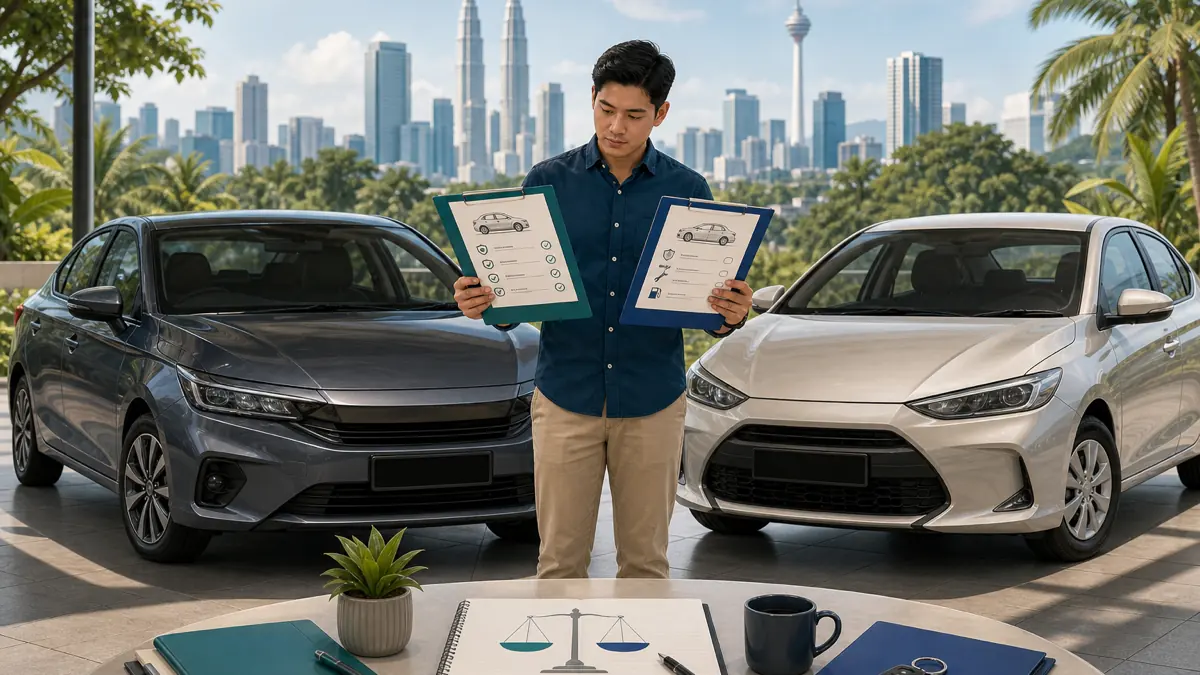
01Two cars that refuse to lose value
Ask any Malaysian which used sedans hold their price, and the Honda City and Toyota Vios come up first — for good reason.
These are the two dominant B-segment sedans in the country. Both have sold in huge numbers to private buyers and to the e-hailing fleet, both have parts on every shelf and a service centre in every town, and both attract a broad, patient pool of second-hand buyers. That combination — deep demand, cheap upkeep, and wide support — is exactly what protects resale value over time.
B-segment
Both are core mass-market sedans
The most cross-shopped class in Malaysia
Two demand pools
Private buyers + e-hailing
Wider buyer base than niche models
Nationwide
Parts and service everywhere
Low ownership risk keeps prices firm
03Why one specific car is worth more than another
Here is the part badge debates always miss: the spread between two cars of the same model is usually wider than the spread between the City and the Vios. A premium Vios with full records and low mileage can sit well above a tired base-spec City — and the reverse is just as true.
| Factor | Typical direction | Why the market reacts |
|---|---|---|
| Below-average mileage | Premium | Lower perceived wear and remaining-life risk |
| Full service history | Premium | Verifiable care removes the buyer's unknowns |
| Higher variant (V / G) | Premium | More equipment and a more desirable spec |
| Accident-free, clean body | Premium | Easier inspection and easier future resale |
| Heavy ex-e-hailing mileage | Discount | High hours and hard use shorten remaining life |
| Accident or flood history | Discount | Higher risk and a harder resale later |
So the practical question is never "City or Vios?" in the abstract. It is whether this City or this Vios — at its year, variant, mileage, condition, and history — is priced correctly against the cars a buyer can actually choose right now. That is a job for evidence, not loyalty.
04Illustrative retained value
Both badges hold a strong share of their original value, and the curves track each other closely. The figures below are illustrative bands for a well-kept, average-mileage example of each — not a guaranteed price — to show the shape of the comparison rather than to crown a winner.
05How to decide without picking sides
If you are buying, the goal is the best car for the money — which may be a City on one week's listings and a Vios on the next. If you are selling, the goal is to defend a fair price with evidence the buyer cannot argue with.
Compare like with like, then let the evidence decide:
- Match variant to variant — a City V against a Vios G, not a base car against a top spec.
- Match mileage and year so you are comparing wear, not just nameplates.
- Account for region and liquidity — a Klang Valley unit is easier to sell than a thin-market one.
- Weigh condition and history — records, accident-free status, and a clean body move the price more than the badge.
- Run both through a Carvaly valuation and compare the verdicts, not the reputations.
The strongest position in a City-vs-Vios negotiation is not loyalty — it is being the person who can show why this exact car is worth this exact price.
Frequently asked questions
Does the Honda City or Toyota Vios hold its value better in Malaysia?
Both hold value strongly and the curves are close. Across the market neither has a decisive, universal edge — the difference between two specific cars almost always comes down to variant, mileage, condition, accident history, and region, which outweigh the badge. Value each exact car rather than trusting a blanket rule.
Is an ex-e-hailing City or Vios worth buying?
It can be, if the price reflects the use. Ex-e-hailing cars often carry high mileage and hard hours, so they should sit below a comparable private-use car. The Vios's durability reputation is part of why it is a fleet favourite, but you still pay for condition and records — verify the service history and inspect carefully, then price for the actual wear.
Which variant should I look at to maximise resale?
Higher variants (City V, Vios G) carry more equipment and tend to stay desirable, which supports resale — but only if the condition and records back it up. A well-kept mid variant with full history can resell more easily than a neglected top variant. Spec helps; condition and evidence decide.
Why is my City or Vios worth less than the figure I saw quoted?
Quoted figures are averages built from cars that may differ from yours in mileage, variant, condition, and region. If similar cars near your buyer are cheaper, your realistic price follows them. Get a Carvaly valuation for estimated ranges you can save and share instead of an average.
Are these resale figures guaranteed prices?
No. Any retained-value band is illustrative and varies by the exact car and local supply. Carvaly gives estimated ranges you can save and share, but it is not a mechanical inspection or a guaranteed sale price — treat it as a report behind your number, not a promise.